
Margaret Ward and the 1930s Divination Craze: A History of Gong Hee Fot Choy
Written by: Cleo Divine
Published on: January 16, 2026
Category:
Oracles & Divination
In the midst of the Great Depression, while America struggled with economic collapse and social upheaval, a small red book began appearing in parlors across the country. It promised "Greetings of Riches" and offered a structured path to luck in an era that seemed to have none. This is the story of Margaret Ward - a woman who blended ancient Chinese philosophy with Western cartomancy to create a cultural phenomenon that survives to this day.
I. Who Was Margaret Ward? The Woman Behind the Luck
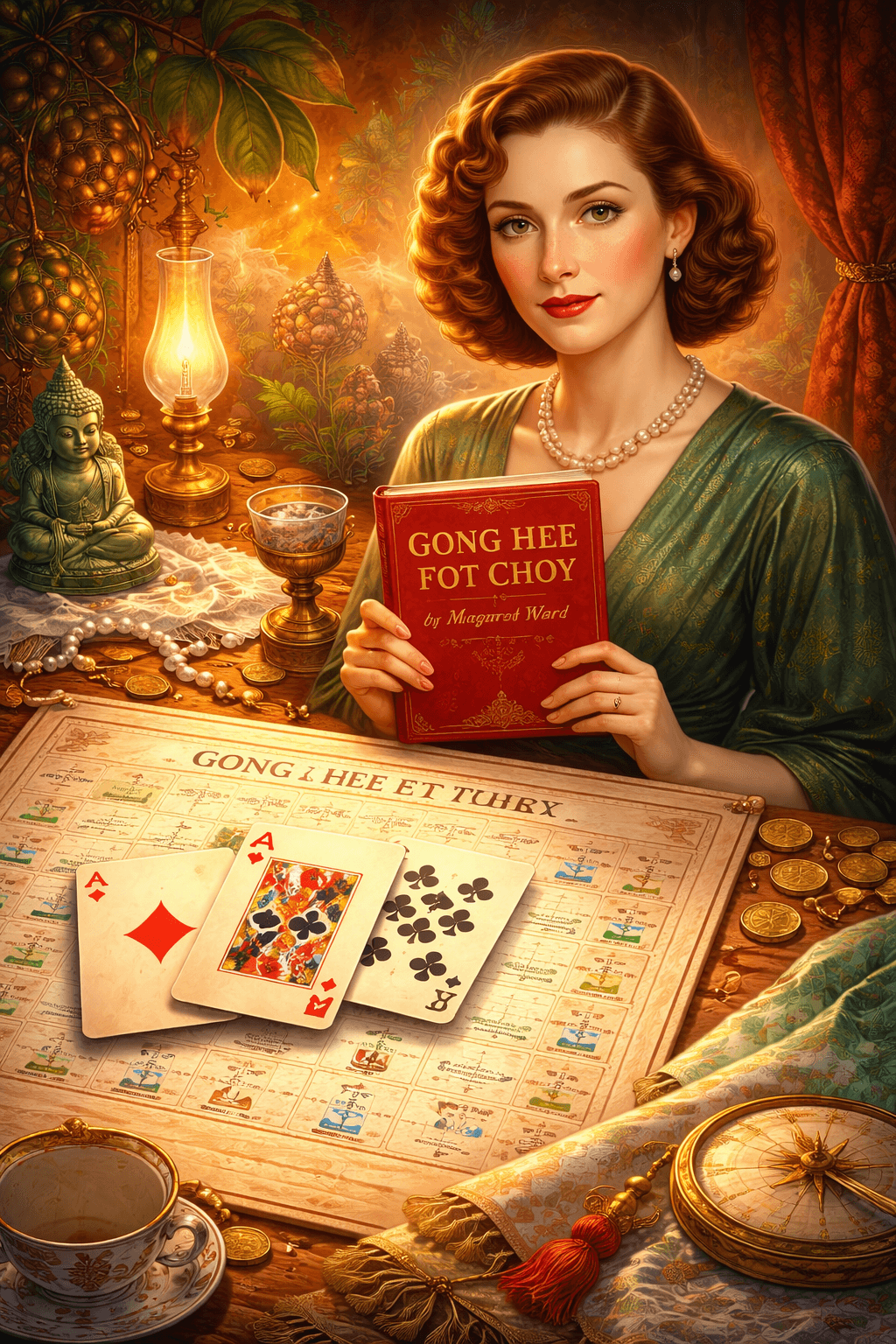
Very little is known about the early life of Margaret Ward, but her impact on 20th-century divination is undeniable. In 1935, she published the first edition of Gong Hee Fot Choy. Ward claimed to have lived in China for many years, where she studied traditional Chinese mysticism and the concept of the 32 "Houses of Fate."
She observed that while the Western world relied heavily on the Tarot - which was often viewed as complex or even "dark" by the conservative public of the 1930s - there was a massive opening for a system that felt "lucky," approachable, and used common playing cards. Her genius was in the branding: she didn't sell a "fortune-telling kit"; she sold a "Book of Luck."
II. Divination in the Dust Bowl: Why the Gong Succeeded
The success of Gong Hee Fot Choy cannot be separated from the era in which it was born. During the 1930s, the "American Dream" felt like a distant memory for many. When people lose faith in traditional systems - the banks, the government, the job market - they often turn to the mystical to find a sense of agency.
Gong Hee Fot Choy offered a specific kind of hope. It focused heavily on financial prosperity, success, and domestic stability. While other systems might focus on spiritual growth or past lives, Ward's system asked the questions that kept people awake at night: Will I find work? Will my family be healthy? Is easy money coming my way?
III. Chinoiserie and the Western Fascination
The 1920s and 30s saw a massive trend in "Chinoiserie" - a Western interpretation of Chinese artistic styles. From Mahjong sets to Hollywood set designs, the "Orient" was viewed as a place of deep, untapped wisdom. Margaret Ward leaned heavily into this aesthetic.
The name itself, Gong Hee Fot Choy, is a phonetic Westernization of a Cantonese New Year greeting (Gung Hei Fat Choi). By using this name and the 32-house grid (reminiscent of Chinese numerology), Ward gave her system an air of "ancient authority" that fascinated a public looking for answers outside of the traditional Western canon.
A digital recreation of the iconic 1930s "Red Book of Luck" aesthetic.
IV. The Evolution of the 32 Houses
One of the most interesting historical footnotes is the choice of the number 32. In many card systems, 32 represents a "Piquet" deck-a standard deck with the 2s through 6s removed. This was common in Europe for games and fortune-telling, and Ward integrated it seamlessly into her "Houses."
Over the decades, the meanings of these houses have evolved. In 1935, "House 14 (Letters)" meant physical mail delivered by a postman. Today, we interpret it as digital communication, emails, and news from across the globe. The system has survived precisely because its framework is rigid enough to provide structure, but flexible enough to adapt to the changing technology of the 21st century.
V. The Post-War Boom: Gong Hee Fot Choy in the 1950s
Following the end of World War II, the American cultural landscape shifted from the grit of the Depression to the polished optimism of the 1950s. While many occult tools faded into the background during this era of suburban conformity, Gong Hee Fot Choy experienced a unique "quiet boom." It transitioned from a tool of desperate hope to a sophisticated social activity for the mid-century hostess.
During this period, Margaret Ward's system was frequently marketed as a high-society parlor game. It was not uncommon to see the iconic red board laid out on a coffee table next to a set of bridge cards. The system's focus on "Success" and "The House of Marriage" resonated perfectly with the era's emphasis on upward mobility and domestic stability. It was during these years that the system was refined for a faster-paced world, emphasizing the "Daily Pull" method that many users of our Online Gong Tool still use today.
VI. The "Piquet" Influence and Mid-Century Design
Historically, the deck used for Gong Hee Fot Choy was the 32-card "Piquet" deck. This was a standard deck with the 2s, 3s, 4s, 5s, and 6s removed. In the 1950s, as card games like Canasta and Bridge dominated social life, many families already had multiple decks on hand, making it easy to "set up" a Gong board at a moment's notice.
Design-wise, the 1950s editions of the board began to lean into a more "atomic age" aesthetic, though they never fully abandoned the classic Chinese-inspired scrollwork. This visual consistency is a hallmark of the Ward system-it feels like a bridge between the ancient past and the modern present. Whether printed on heavy cardstock in 1955 or rendered in pixels in 2026, the 32-house grid remains the unchanging skeleton of the oracle.
A timeline showing the stylistic shifts from Margaret Ward's original vision to the modern digital era.
VII. The 1970s: The New Age and the Return to Ward
As the cultural pendulum swung toward the "Me Generation" and the explosion of the New Age movement in the 1970s, Gong Hee Fot Choy underwent a massive revitalization. This was the era of the mass-market paperback, and new editions of Margaret Ward's work began to flood bookstores once again. For a generation exploring alternative spiritualities-ranging from Zen Buddhism to Western Astrology - the "Gong" was a perfect synthesis.
During this decade, the system was rediscovered by practitioners of "Shadow Work" and psychological divination. Users began to look past the "Easy Money" and "Riches" labels to see the system's deep psychological merit. They realized that by mapping their subconscious through 32 fixed houses, they could perform a form of self-analysis that was faster and more focused than a full Tarot spread. The 1970s "Paperback Revolution" ensured that every household had a copy of the 32 houses, much like the original craze of 1935.
VIII. The Digital Leap: Gong Hee Fot Choy in the Internet Age
The true "immortality" of the Gong system was achieved in the late 1990s with the advent of the World Wide Web. Unlike a physical board which could be lost or a book that could go out of print, a digital version of the 32 houses could be accessed by anyone, anywhere, at any time. e-Tarocchi was among the first platforms to recognize this potential, translating the intricate logic of the Ward system into a clean, digital interface.
The digital leap solved a major barrier for many new seekers: the setup. In a traditional physical reading, the user has to manually remove specific cards from a deck and carefully place them on a large, often cumbersome paper board. Our digital tool automates this process, allowing the user to focus entirely on the Interpretation rather than the mechanics. This has led to a massive increase in younger users-the "digital natives" - who appreciate the system's speed and scannable clarity.
IX. Greetings of Riches: The Global Spread of the System
While Gong Hee Fot Choy is fundamentally an American creation, its roots in Chinese philosophy allowed it to travel far beyond the borders of the United States. By the late 1940s, the "Red Book of Luck" had found its way to the United Kingdom, Australia, and Canada. In these regions, the system was often marketed as a bridge between the mystical traditions of the East and the pragmatic cartomancy of the West.
The phonetic name, Gong Hee Fot Choy, presented a unique challenge in non-English speaking markets. In some European translations, the name was simplified to "The Chinese Compass" or "The 32 Houses of Fortune." However, the core mechanics remained untouched. This global spread proved that the desire for a structured, "house-based" divination system was universal. Whether a seeker was in London or Los Angeles, the 32 houses provided a shared language of hope and strategic planning during times of global transition.
X. The "Red Book" Market: Collectibility and Vintage Boards
For modern enthusiasts, the history of Gong Hee Fot Choy is not just found in books-it is found in the physical artifacts of the 1930s. Original 1935 editions of Margaret Ward's book, particularly those that include the fold-out paper board and the original box, have become highly sought-after items in the occult collector's market.
Collectors look for specific "markers" of authenticity, such as the specific shade of crimson used on the cover and the texture of the cardstock. There is a prevailing belief in the community that these vintage boards carry the "residual luck" of the millions of seekers who used them during the Great Depression. While our Online Gong Tool provides the same mathematical accuracy, owning a piece of the 1930s history allows practitioners to feel a tangible connection to the lineage of Margaret Ward herself.
The journey of the "Greetings of Riches" from a local Baltimore novelty to an international digital staple.
XI. Why the Gong Remains Relevant in the 2020s
We live in an era characterized by "information overload" and rapid technological change. In such a world, the simplicity and rigidity of the 32 houses are their greatest strengths. Unlike more complex systems that require years of study to master, Gong Hee Fot Choy provides instant clarity. It meets the modern user where they are - on their smartphone, during a coffee break, or in the quiet moments before sleep.
Psychologically, the system serves as a "pattern recognition" tool. By assigning our life events to fixed houses like Success, Health, or Easy Money, we are forced to categorize our experiences. This act of categorization reduces the "noise" of daily anxiety and allows us to see the broader trends of our lives. Margaret Ward's 1930s optimism has found a new home in the 2020s wellness movement, where it is used as a form of "manifestation" and "intentional living."
XII. The Future of Margaret Ward's Legacy
The history of Gong Hee Fot Choy is still being written. As we look toward the future, we see a continued convergence of ancient wisdom and modern technology. We are currently exploring ways to integrate even more detailed historical context into every reading, ensuring that the voice of Margaret Ward continues to resonate through the digital interface.
The "Greetings of Riches" is not a fossil of the 1930s; it is a living, breathing oracle. It survived the Great Depression, the World Wars, and the transition to the digital age. It survives because humans will always need a way to look at the cards, find their house, and believe that, just maybe, a bit of "Easy Money" is waiting just around the corner.
Final Thoughts: A Century of Seeking
Whether you are a historian of the occult or a daily seeker of luck, the story of Gong Hee Fot Choy is a testament to the power of American ingenuity and spiritual curiosity. From the red-covered books of 1935 to the pixels on your screen today, the 32 houses remain open for those who dare to ask the cards for a glimpse into the unknown.
Respect the history, embrace the tradition, and may your next reading bring you the "Greetings of Riches" that Margaret Ward promised nearly a century ago.
Step into history. Start your reading today.
Launch the Online Gong Tool