
Halloween Articles
How the Jack-O-Lantern Came to Be
October 16, 2011 | Terry Kaufman
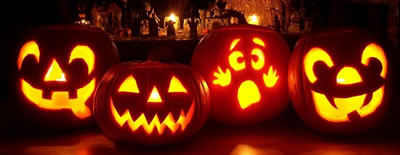
Jack and Satan made a deal: Jack would allow the Devil to get out of the tree, on the condition that the Devil never tried to tempt Jack to go astray ever again.
Jack had dug himself into the proverbial hole: when he died, he was denied entry into Heaven because of his evil ways. Hell refused him entrance because he had tricked the Devil. Satan gave Jack a single ember to guide his way through the bitterly cold blackness. A hollowed - out turnip was used to hold the ember, allowing the flame to continue glowing.
Jack's punishment was to walk in neverending darkness; he carried a fiery coal inside an emptied - out turnip to help him see wherever he traveled. After a while, he came to be known as "Jack of the Lantern" or "Jack O'Lantern.
Turnips were originally used in Ireland as lanterns. However, Irishmen migrating to America soon learned that turnips were not nearly as plentiful as were pumpkins. The American settlers quickly adopted the pumpkin as the squash of choice for their Jack O'Lantern, complete with a glowing ember.
When carving your Jack O'Lantern you will need the correct tools to produce your masterpiece. To get good results you will need knives and other implements that are sharp, flexible, thin, and sturdy.
A long, thin-bladed boning knife is the ideal tool with which to cut the top hole and any large pieces from the face of the pumpkin. Detail work can be done with a very thin-bladed paring knife. Several different types and sizes of spoons do a great job removing seeds, pulp, and skin from the inside of the pumpkin. A large metal ladle or an ice cream scoop are perfect for scrapping.
There are many Halloween superstitions floating around to entertain us. The black cat is thought to have magical powers: certain bones are reputed to make wishes come true or to make someone invisible. A bizarre superstition involves snails. Some believers who embrace the tales of the Old World say that if you catch a snail on Halloween night and lock it into a flat dish, upon rising in the morning you will see the first initial of your sweetheart's name written in the snail slime. Yuck!
About the Author
Terry Kaufman is Chief Editorial Writer for www.niftykitchen.com and www.niftyhomebar.com. See more on Halloween, at www.niftyhomebar.com/site/372135/page/93653.
Samhain - The Origin of Halloween
October 9, 2011 | Tonia Jordan
Samhain Eve was a time of reflection for the Celts, and a time for honoring the dead. This particular time of year signified the final harvest, a time of gathering and preparing for winter. Often winter was a time of famine and some would not survive through the long months ahead. Samhain was a way of honoring those who had died, a celebration of the spirit remembered.
It was a common belief that the "veil" between the world of the living and the world of the dead was thinnest on the eve of Samhain. In Modern times, many have twisted this thought to evil intent, though its origin is much more honorable. The dead could return on this one night to the places where they had lived, and food and entertainment were provided in their honor. This symbolized a village existing in harmony with its past, present and future.
This also led to the tradition of lighting a single candle in a window, to light the way for ancestors to find their way home. Food offerings were also left on doorsteps for the spirits (which led to our modern "trick or treating").
It was the Romans who added their "Feast of the Dead" to the celebration of Samhain. The Christians destabilized the holiday by introducing "All Saint's Day" on November 1st, and re-naming October 31st to All Hallow's Eve, which later became Hallowe'en. For Christians, All Saints Day celebrates the spirits in Heaven and Purgatory. It became customary to bang pots and pans together on the eve of All Saint's Day, to let the souls in Hell know they weren't forgotten.
Samhain is also a major celebration of Wiccans, one of their eight holy Sabbats. For Wiccans, it is also a time of celebrating the past and the future to come. Many Pagans celebrate the New Year at this time.
Though the holiday has changed over the years, its intent remains clear - it is a celebration of respect for the dead and a celebration of the new beginning that is to come. It is a holiday that commemorates the togetherness of a community.
Tonia Jordan is an author on http://www.writing.com/ which is a site for Writers.
She is also a stringer for the Standard Speaker, a Pennsylvania newspaper, and is editor of Word of Mouth Magazine.