
Tarot Articles
The Fool's Journey: A 2,000-Word Masterclass on the 22 Major Arcana
January 2, 2026 | Cleo Divine
The Tarot is far more than a tool for telling the future; it is a profound symbolic language that maps the human soul's evolution from ignorance to enlightenment.
Tarot Foundations: From the Fool to the World
December 23, 2025 | Cleo Divine
Journey through the archetypes of the Tarot. Learn the history of the cards and how to perform your own readings.
P.D. Ouspensky's Vision: A Mystical Journey Through the Major Arcana
October 1, 2025 | Cleo Divine
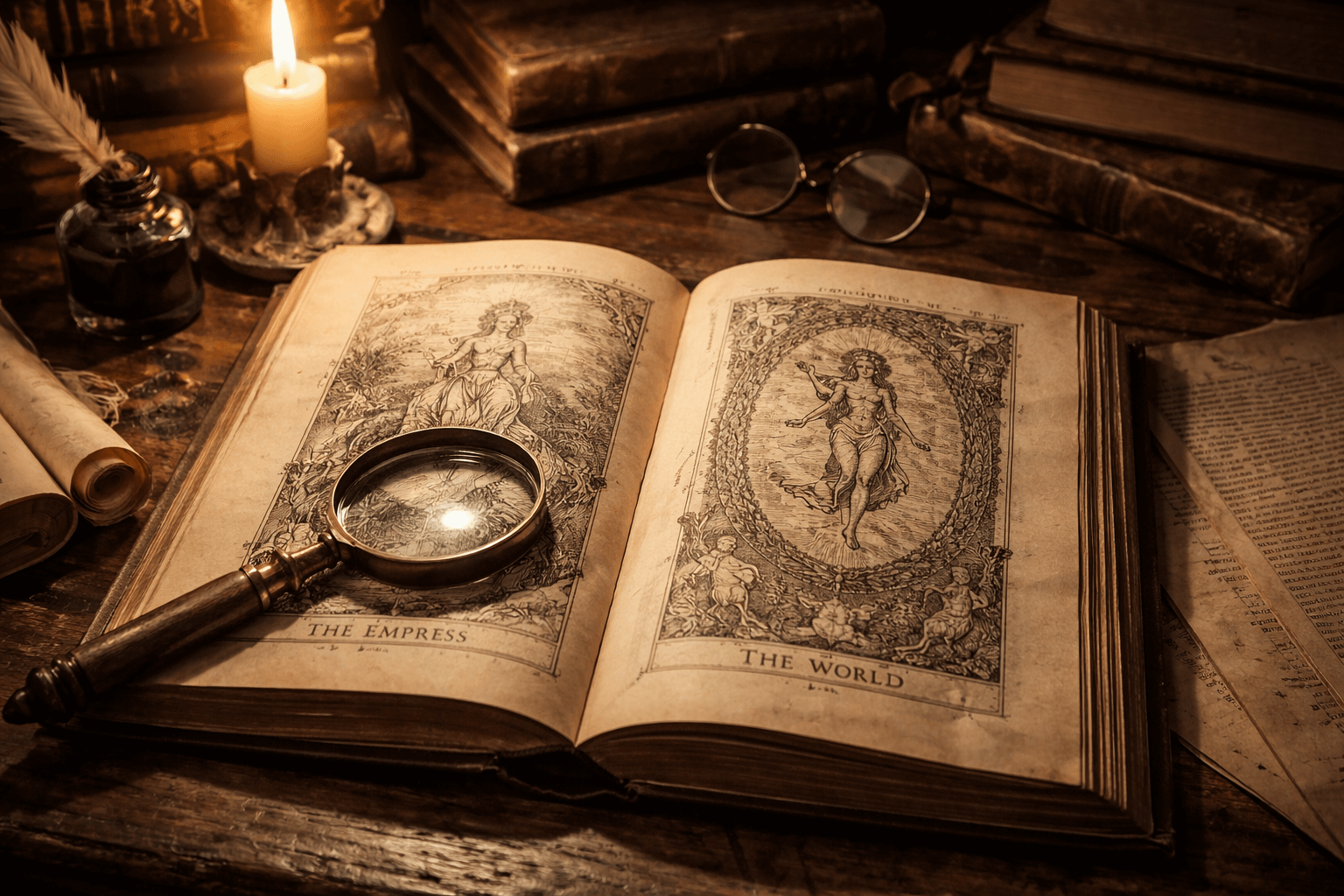
P.D. Ouspensky, the renowned Russian philosopher and mathematician, viewed the Tarot not merely as a tool for divination, but as a "Symbolic System" of the universe. For Ouspensky, the Major Arcana represented a series of cosmic psychological steps - a "Deck of Life" that mirrored the inner evolution of the human soul.
In Ouspensky's vision, The Empress is the personification of the creative, formative power of the world. She is not just a maternal figure; she is the radiant energy that gives life to form. When Ouspensky contemplated this card, he saw the eternal feminine as the source of all inspiration and the very breath of nature itself.
P. D. Ouspensky's Journey Through the Major Arcana:THE EMPRESS
June 6, 2012 | Julian Laster
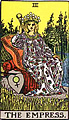
In the midst of a green meadow where primroses bloomed, I saw the Empress seated on a throne covered with ivy and lilacs. A green wreath adorned her golden hair and, above her head, shone twelve stars. Behind her rose two snowy wings and in her hands she held a sceptre. All around, beneath the sweet smile of the Empress, flowers and buds opened their dewy, green leaves. Her whole dress was covered with them as though each newly opened flower were reflected in it or had engraved itself thereon and thus become part of her garment.
The sign of Venus, the goddess of love, was chiseled on her marble throne.
"Queen of life," I said, "why is it so bright and joyful all about you? Do you not know of the grey, weary autumn, of the cold, white winter? Do you not know of death and graveyards with black graves, damp and cold? How can you smile so joyfully on the opening flowers, when everything is destined to death, even that which has not yet been born?"
For answer the Empress looked on me still smiling and, under the influence of that smile, I suddenly felt a flower of some clear understanding open in my heart.
Tarot: The Fool
March 20, 2012 | Julian Laster
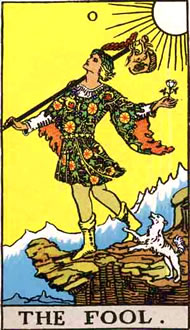
Before him a crevice crossed the road and a deep precipice awaited the foolish wanderer. Then a huge crocodile with open mouth crawled out of the precipice. And I heard the voice say:--"Look! This is the same man."
I felt my head whirl.
"What has he in the bag?" I inquired, not knowing why I asked. And after a long silence the voice replied: "The four magic symbols, the sceptre, the cup, the sword and the pentacle. The fool always carries them, although he has long since forgotten what they mean. Nevertheless they belong to him, even though he does not know their use. The symbols have not lost their power, they retain it in themselves.
Tarot: The Magician
March 13, 2012 | Julian Laster
P. D. Ouspensky's Journey Through the Major Arcana
Introduction
The work below was sent to me by an anonymous contributor. From what I was told it is an excerpt from a much larger piece of work by P. D. Ouspensky that was published in the early part of the 20th Century.
Apparently Ouspensky rearranged the cards of the Major Arcana and then gave his imagination free rein to journey through them. The text below is the result of his venture. The writing is quite eloquent at times and certainly merits an audience. The cards and descriptions are presented in the same order as the author used.
THE MAGICIAN
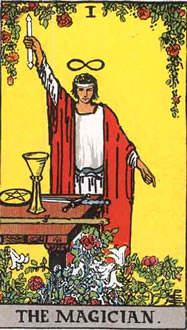
I Saw the Man.
His figure reached from earth to heaven and was clad in a purple mantle. He stood deep in foliage and flowers and his head, on which was the head-band of an initiate, seemed to disappear mysteriously in infinity.
Before him on a cube-shaped altar were four symbols of magic--the sceptre, the cup, the sword and the pentacle.
His right hand pointed to heaven, his left to earth. Under his mantle he wore a white tunic girded with a serpent swallowing its tail.
His face was luminous and serene, and, when his eyes met mine, I felt that he saw most intimate recesses of my soul. I saw myself reflected in him as in a mirror and in his eyes I seemed to look upon myself.
And I heard a voice saying:
--"Look, this is the Great Magician!
With his hands he unites heaven and earth, and the four elements that form the world are controlled by him.
The four symbols before him are the four letters of the name of God, the signs of the four elements, fire, water, air, earth."
I trembled before the depth of the mysteries touched... The words I heard seemed to be littered by the Great Magician himself, and it was as though he spoke in me.
I was in deep trepidation and at moment I felt there was nothing, before me except the blue sky; but within me a window opened through which I could see unearthly things. and hear unearthly words.
An Analysis of Tarot Cards
July 21, 2011 | Manly P. Hall
"That cards were brought by the home-returning warriors, who imported many of the newly acquired customs and habits of the Orient to their own countries, seems to be a well-established fact; and it does not contradict the statement made by some writers who declared that the gypsies--who about that time began to wander over Europe--brought with them and introduced cards, which they used, as they do at the present day, for divining the future." (See The Devil's Picture Books.)
Through the Gypsies the Tarot cards may be traced back to the religious symbolism of the ancient Egyptians. In his remarkable work, The Gypsies, Samuel Roberts presents ample proof of their Egyptian origin. In one place he writes: "When Gypsies originally arrived in England is very uncertain. They are first noticed in our laws, by several statutes against them in the reign of Henry VIII.; in which they are described as 'an outlandish people, calling themselves Egyptians,--who do not profess any craft or trade, but go about in great numbers.'" A curious legend relates that after the destruction of the Serapeum in Alexandria, the large body of attendant priests banded themselves together to preserve the secrets of the rites of Serapis. Their descendants (Gypsies) carrying with them the most precious of the volumes saved from the burning library--the Book of Enoch, or Thoth (the Tarot)--became wanderers upon the face of the earth, remaining a people apart with an ancient language and a birthright of magic and mystery.
Court de Gebelin believed the word Tarot itself to be derived from two Egyptian words, Tar, meaning "road," and Ro, meaning "royal." Thus the Tarot constitutes the royal road to wisdom. (See Le Monde Primitif.) In his History of Magic, P. Christian, the mouthpiece of a certain French secret society, presents a fantastic account of a purported initiation into the Egyptian Mysteries wherein the 22 major Tarots assume the proportions of trestleboards of immense size and line a great gallery. Stopping before each card in turn, the initiator described its symbolism to the candidate. Edouard Schure, whose source of information was similar to that of Christian's, hints at the same ceremony in his chapter on initiation into the Hermetic Mysteries. (See The Great Initiates.) While the Egyptians may well have employed the Tarot cards in their rituals, these French mystics present no evidence other than their own assertions to support this theory. The validity also of the so-called Egyptian Tarots now in circulation has never been satisfactorily established. The drawings are not only quite modem but the symbolism itself savors of French rather than Egyptian influence.
The Tarot is undoubtedly a vital element in Rosicrucian symbolism, possibly the very book of universal knowledge which the members of the order claimed to possess. The Rota Mundi is a term frequently occurring in the early manifestoes of the Fraternity of the Rose Cross. The word Rota by a rearrangement of its letters becomes Taro, the ancient name of these mysterious cards. W. F. C. Wigston has discovered evidence that Sir Francis Bacon employed the Tarot symbolism in his ciphers. The numbers 21, 56, and 78, which are all directly related to the divisions of the Tarot deck, are frequently involved in Bacon's cryptograms. In the great Shakespearian Folio of 1623 the Christian name of Lord Bacon appears 21 times on page 56 of the Histories. (See The Columbus of Literature.)
Many symbols appearing upon the Tarot cards have definite Masonic interest. The Pythagorean numerologist will also find an important relationship to exist between the numbers on the cards and the designs accompanying the numbers. The Qabbalist will be immediately impressed by the significant sequence of the cards, and the alchemist will discover certain emblems meaningless save to one versed in the divine chemistry of transmutation and regeneration.' As the Greeks placed the letters of their alphabet--with their corresponding numbers--upon the various parts of the body of their humanly represented Logos, so the Tarot cards have an analogy not only in the parts and members of the universe but also in the divisions of the human body.. They are in fact the key to the magical constitution of man.
The Tarot cards must be considered (1) as separate and complete hieroglyphs, each representing a distinct principle, law, power, or element in Nature; (2) in relation to each other as the effect of one agent operating upon another; and (3) as vowels and consonants of a philosophic alphabet. The laws governing all phenomena are represented by the symbols upon the Tarot cards, whose numerical values are equal to the numerical equivalents of the phenomena. As every structure consists of certain elemental parts, so the Tarot cards represent the components of the structure of philosophy. Irrespective of the science or philosophy with which the student is working, the Tarot cards can be identified with the essential constituents of his subject, each card thus being related to a specific part according to mathematical and philosophical laws. "An imprisoned person," writes Eliphas Levi, "with no other book than the Tarot, if he knew how to use it, could in a few years acquire universal knowledge, and would be able to speak on all subjects with unequalled learning and inexhaustible eloquence. " (See Transcendental Magic.)
The diverse opinions of eminent authorities on the Tarot symbolism are quite irreconcilable. The conclusions of the scholarly Court de Gebelin and the bizarre Grand Etteila--the first authorities on the subject--not only are at radical variance but both are equally discredited by Levi, whose arrangement of the Tarot trumps was rejected in turn by Arthur Edward Waite and Paul Case as being an effort to mislead students. The followers of Levi--especially Papus, Christian, Westcott, and Schure-are regarded by the "reformed Tarotists" as honest but benighted individuals who wandered in darkness for lack of Pamela Coleman Smith's new deck of Tarot cards with revisions by Mr. Waite.
Most writers on the Tarot (Mr. Waite a notable exception) have proceeded upon the hypothesis that the 22 major trumps represent the letters of the Hebrew alphabet. This supposition is based upon nothing more substantial than the coincidence that both consist of 22 parts. That Postel, St. Martin, and Levi all wrote books divided into sections corresponding to the major Tarots is an interesting sidelight on the subject. The major trump cards portray incidents from the Book of Revelation; and the Apocalypse of St. John is also divided into 22 chapters. Assuming the Qabbalah to hold the solution to the Tarot riddle, seekers have often ignored other possible lines of research. The task, however, of discovering the proper relationship sustained by the Tarot trumps to the letters of the Hebrew alphabet and the Paths of Wisdom thus far has not met with any great measure of success. The major trumps of the Tarot and the 22 letters of the Hebrew alphabet cannot be synchronized without first fixing the correct place of the unnumbered, or zero, card--Le Mat, the Fool. Levi places this card between the 20th and 21st Tarots, assigning to it the Hebrew letter Shin (?). The same order is followed by Papus, Christian, and Waite, the last, however, declaring this arrangement to be incorrect. Westcott makes the zero card the 22nd of the Tarot major trumps. On the other hand, both Court de Gebelin and Paul Case place the unnumbered card before the first numbered card of the major trumps, for if the natural order of the numbers (according to either the Pythagorean or Qabbalistic system) be adhered to, the zero card must naturally precede the number 1.
From Chatto's Origin and History of Playing Cards:
In writing of the deck from which the four cavaliers (jacks) here reproduced were taken, William Andrew Chatto notes: "Some of the specimens of Portuguese cards given in the 'Jeux de Cartes, Tarots et de Cartes Numerales' have very much the appearance of having been originally suggested by, if net copied from, an Oriental type; more especially in the suits of Danari and Bastani,--Money and Clubs. In those cards the circular figure, generally understood as representing Danari, or Money, is certainly much more like the Chakra, or quoit of Vichnou [Vishnu], as seen in Hindostanic drawings, than a piece of coin; while on the top of the Club is a diamond proper, which is another of the attributes of the same deity." Also worthy of note are the Rosicrucian and Masonic emblems appearing on various medieval decks. As the secrets of these organizations were often concealed in cryptic engravings, it is very probable that the enigmatic diagrams upon various decks of cards were used both to conceal and to perpetuate the political and philosophical arcana of these orders. The frontispiece of Mr. Chatto's books shows a knave of hearts bearing a shield emblazoned with a crowned Rosicrucian rose.
This does not dispose of the problem, however, for efforts to assign a Hebrew letter to each Tarot trump in sequence produce an effect far from convincing. Mr. Waite, who reedited the Tarot, expresses himself thus: "I am not to be included among those who are satisfied that there is a valid correspondence between Hebrew letters and Tarot Trump symbols." (See introduction to The Book of Formation by Knut Stenring.) The real explanation may be that the major Tarots no longer are in the same sequence as when they formed the leaves of Hermes' sacred book, for the Egyptians--or even their Arabian successors--could have purposely confused the cards so that their secrets might be better preserved. Mr. Case has developed a system which, while superior to most, depends largely upon two debatable points, namely, the accuracy of Mr. Waite's revised Tarot and the justification for assigning the first letter of the Hebrew alphabet to the unnumbered, or zero, card. Since Aleph (the first Hebrew letter) has the numerical value of 1, its assignment to the zero card is equivalent to the statement that zero is equal to the letter Aleph and therefore synonymous with the number 1.
With rare insight, Court de Gebelin assigned the zero card to AIN SOPH, the Unknowable First Cause. As the central panel of the Bembine Table represents the Creative Power surrounded by seven triads of manifesting divinities, so may the zero card represent that Eternal Power of which the 21 surrounding or manifesting aspects are but limited expressions. If the 21 major trumps be considered as limited forms existing in the abstract substance of the zero card, it then becomes their common denominator. Which letter, then, of the Hebrew alphabet is the origin of all the remaining letters? The answer is apparent: Yod. In the presence of so many speculations, one more may not offend. The zero card--Le Mat, the Fool--has been likened to the material universe because the mortal sphere is the world of unreality. The lower universe, like the mortal body of man, is but a garment, a motley costume, well likened to cap and bells. Beneath the garments of the fool is the divine substance, however, of which the jester is but a shadow; this world is a Mardi Gras--a pageantry of divine sparks masked in the garb of fools. Was not this zero card (the Fool) placed in the Tarot deck to deceive all who could not pierce the veil of illusion?
The Tarot cards were entrusted by the illumined hierophants of the Mysteries into the keeping of the foolish and the ignorant, thus becoming playthings--in many instances even instruments of vice. Man's evil habits therefore actually became the unconscious perpetuators of his philosophical precepts. "We must admire the wisdom of the Initiates," writes Papus, "who utilized vice and made it produce more beneficial results than virtue." Does not this act of the ancient priests itself afford proof that the entire mystery of the Tarot is wrapped up in the symbolism of its zero card? If knowledge was thus entrusted to fools, should it not be sought for in this card?
If Le Mat be placed before the first card of the Tarot deck and the others laid out in a horizontal line in sequence from left to right, it will be found that the Fool is walking toward the other trumps as though about to pass through the various cards. Like the spiritually hoodwinked and bound neophyte, Le Mat is about to enter upon the supreme adventure--that of passage through the gates of the Divine Wisdom. If the zero card be considered as extraneous to the major trumps, this destroys the numerical analogy between these cards and the Hebrew letters by leaving one letter without a Tarot correspondent. In this event it will be necessary to assign the missing letter to a hypothetical Tarot card called the elements, assumed to have been broken up to form the 56 cards of the minor trumps. It is possible that each of the major trumps may be subject to a similar division.
The first numbered major trump is called Le Bateleur, the juggler, and according to Court de Gebelin, indicates the entire fabric of creation to be but a dream, existence a juggling of divine elements, and life a perpetual game of hazard. The seeming miracles of Nature are but feats of cosmic legerdemain. Man is like the little ball in the hands of the juggler, who waves his wand and, presto! the ball vanishes. The world looking on does not realize that the vanished article is still cleverly concealed by the juggler in the hollow of his hand. This is also the Adept whom Omar Khayyam calls "the master of the show." His message is that the wise direct the phenomena of Nature and are never deceived thereby.
The magician stands behind a table on which are spread out a number of objects, prominent among them a cup--the Holy Grail and the cup placed by Joseph in Benjamin's sack; a coin--the tribute money and the wages of a Master Builder, and a sword, that of Goliath and also the mystic blade of the philosopher which divides the false from the true. The magician's hat is in the form of the cosmic lemniscate, signifying the first motion of creation. His right hand points to the earth, his left holds aloft the rod of Jacob and also the staff that budded--the human spine crowned with the globe of creative intelligence. In the pseudo-Egyptian Tarot the magician wears an ureus or golden band around his forehead, the table before him is in the form of a perfect cube, and his girdle is the serpent of eternity devouring its own tail.
The second numbered major trump is called La Papesse, the Female Pope, and has been associated with a curious legend of the only woman who ever sat in the pontifical chair. Pope Joan is supposed to have accomplished this by masquerading in malt attire, and was stoned to death when her subterfuge was discovered. This card portrays a seated woman crowned with a tiara surmounted by a lunar crescent. In her lap is the Tora, or book of the Law (usually partly closed), and in her left hand are the keys to the secret doctrine, one gold and the other silver. Behind her rise two pillars (Jachin and Boaz) with a multicolored veil stretched between. Her throne stands upon a checker-hoard floor. A figure called Juno is occasionally substituted for La Papesse. like the female hierophant of the Mysteries of Cybele, this symbolic figure personifies the Shekinah, or Divine Wisdom. In the pseudo-Egyptian Tarot the priestess is veiled, a reminder that the full countenance truth is not revealed to uninitiated man. A veil also covers one-half of her book, thus intimating that but one-half of the mystery of being can be comprehended.
The third numbered major trump is called L'Imperatrice, the Empress, and has been likened to the "woman clothed with the sun" described in the Apocalypse. On this card appears the winged figure of a woman seated upon a throne, supporting with her right hand a shield emblazoned with a phoenix and holding in her left a scepter surmounted by an orb or trifoliate flower. Beneath her left foot is sometimes shown the crescent. Either the Empress is crowned or her head is surrounded by a diadem of stars; sometimes both. She is called Generation, and represents the threefold spiritual world out of which proceeds the fourfold material world. To the graduate of the College of the Mysteries she is the Alma Mater out of whose body the initiate has "born again." In the pseudo-Egyptian Tarot the Empress is shown seated upon a cube filled with eyes and a bird is balanced upon the forefinger other left hand. The upper part of her body is surrounded by a radiant golden nimbus. Being emblematic of the power from which emanates the entire tangible universe, L'Imperatrice is frequently symbolized as pregnant.
The fourth numbered major trump is called L'Empereur, the Emperor, and by its numerical value is directly associated with the great Deity revered by the Pythagoreans under the form of the tetrad. His symbols declare the Emperor to be the Demiurgus, the Great King of the inferior world. The Emperor is dressed in armor and his throne is a cube stone, upon which a phoenix is also clearly visible. The king has his legs crossed in a most significant manner and carries either a scepter surmounted by an orb or a scepter in his right hand and an orb n his left. The orb itself is evidence that he is supreme ruler of the world. Upon his right and left breasts respectively appear the symbols of the sun and moon, which in symbolism are referred to as the eyes of the Great King. The position of the body and legs forms the symbol of sulphur, the sign of the ancient alchemical monarch. In the pseudo-Egyptian Tarot the figure is in profile. He wears a Masonic apron and the skirt forms s right-angled triangle. Upon his head is the Crown of the North and his forehead is adorned wit the coiled ureus.
The fifth numbered major trump is called Le Pape, the Pope, and represents the high priest of a pagan or Christian Mystery school. In this card the hierophant wears the tiara and carries in his left hand the triple cross surmounting the globe of the world. His right hand, bearing upon its back the stigmata, makes "the ecclesiastic sign of esotericism," and before him kneel two suppliants or acolytes. The back of the papal throne is in the form of a celestial and a terrestrial column. This card signifies the initiate or master of the mystery of life and according to the Pythagoreans, the spiritual physician. The illusionary universe in the form of the two figures (polarity) kneels before the throne upon which sits the initiate who has elevated his consciousness to the plane of spiritual understanding and reality. In the pseudo-Egyptian Tarot the Master wears the ureus. A white and a black figure--life and death, light and darkness, good and evil--kneel before him. The initiate's mastery over unreality is indicated by the tiara and the triple cross, emblems of rulership over the three worlds which have issued from the Unknowable First Cause.
The sixth numbered major trump is called L'Amoureux, the Lovers. There are two distinct forms of this Tarot. One shows a marriage ceremony in which a priest is uniting a youth and a maiden (Adam and Eve?) in holy wedlock. Sometimes a winged figure above transfixes the lovers with his dart. The second form of the card portrays a youth with a female figure on either side. One of these figures wears a golden crown and is winged, while the other is attired in the flowing robes of the bacchante and on her head is a wreath of vine leaves. The maidens represent the twofold soul of man (spiritual and animal), the first his guardian angel and the second his ever-present demon. The youth stands at the beginning of mature life, "the Parting of the Ways," where he must choose between virtue and vice, the eternal and the temporal. Above, in a halo of light, is the genius of Fate (his star), mistaken for Cupid by the uninformed. If youth chooses unwisely, the arrow of blindfolded Fate will transfix him. In the pseudo-Egyptian Tarot the arrow of the genius points directly to the figure of vice, thereby signifying that the end of her path is destruction. This card reminds man that the price of free will--or, more correctly, the power of choice--is responsibility.
The seventh numbered major trump is called Le Chariot, the Chariot, and portrays a victorious warrior crowned and riding in a chariot drawn by black and white sphinxes or horses. The starry canopy of the chariot is upheld by four columns. This card signifies the Exalted One who rides in the chariot of creation. The vehicle of the solar energy being numbered seven reveals the arcane truth that the seven planers are the chariots of the solar power which rides victorious in their midst. The four columns supporting the canopy represent the four Mighty Ones who uphold the worlds represented by the star-strewn drapery. The figure carries the scepter of the solar energy and its shoulders are ornamented with lunar crescents--the Urim. and Thummim. The sphinxes drawing the chariot resent the secret and unknown power by which the victorious ruler is moved continuously through the various parts of his universe. In certain Tarot decks the victor signifies the regenerated man, for the body of the chariot is a cubic stone. The man in armor is not standing in the chariot but is rising out of the cube, thus typifying the ascension of the 3 out of the 4--the turning upward of the flap of the Master Mason's apron. In the pseudo-Egyptian Tarot the warrior carries the curved sword of Luna, is bearded to signify maturity, and wears the collar of the planetary orbits. His scepter (emblematic of the threefold universe) is crowned with a square upon which is a circle surmounted by a triangle.
The eighth numbered major trump is called La Justice, Justice, and portrays a seated figure upon a throne, the back of which rises in the form of two columns. Justice is crowned and carries in her right hand a sword and in her left a pair of scales. This card is a reminder of the judgment of the soul in the hall of Osiris. It teaches that only balanced forces can endure and that eternal justice destroys with the sword that which is unbalanced. Sometimes justice is depicted with a braid of her own hair twisted around her neck in a manner resembling a hangman's knot. This may subtly imply that man is the cause of his own undoing, his actions (symbolized by his hair) being the instrument of his annihilation. In the pseudo-Egyptian Tarot the figure of Justice is raised upon a dais of three steps, for justice can be fully administered only by such as have been elevated to the third degree. Justice is blindfolded, that the visible shall in no way influence its decision. (For reasons he considers beyond his readers' intelligence, Mr. Waite reversed the eighth and eleventh major trumps.)
The ninth numbered major trump is called L'Hermite, the Hermit, and portrays an aged man, robed in a monkish habit and cowl, leaning on a staff. This card was popularly supposed to represent Diogenes in his quest for an honest man. In his right hand the recluse carries a lamp which he partly conceals within the folds of his cape. The hermit thereby personifies the secret organizations which for uncounted centuries have carefully concealed the light of the Ancient Wisdom from the profane. The staff of the hermit is knowledge, which is man's main and only enduring support. Sometimes the mystic rod is divided by knobs into seven sections, a subtle reference to the mystery of the seven sacred centers along the human spine. In the pseudo-Egyptian Tarot the hermit shields the lamp behind a rectangular cape to emphasize the philosophic truth that wisdom, if exposed to the fury of ignorance, would be destroyed like the tiny flame of a lamp unprotected from the storm. Man's bodies form a cloak through which his divine nature is faintly visible like the flame of the partly covered lantern. Through renunciation--the Hermetic life--man attains depth of character and tranquility of spirit.
The tenth numbered major trump is called La Roue de Fortune, the Wheel of Fortune, and portrays a mysterious wheel with eight spokes--the familiar Buddhist symbol of the Cycle of Necessity. To its rim cling Anubis and Typhon--the principles of good and evil. Above sits the immobile sphinx, carrying the sword of Justice and signifying the perfect equilibrium of Universal Wisdom. Anubis is shown rising and Typhon descending; but when Typhon reaches the bottom, evil ascends again, and when Anubis reaches the top good wanes once more. The Wheel of Fortune represents the lower universe as a whole with Divine Wisdom (the sphinx) as the eternal arbiter between good and evil. In India, the chakra, or wheel, is associated with the life centers either of a world or of an individual. In the pseudo-Egyptian Tarot the Sphinx is armed with a javelin, and Typhon is being thrown from the wheel. The vertical columns, supporting the wheel and so placed that but one is visible, represent the axis of the world with the inscrutable sphinx upon its northern pole. Sometimes the wheel with its supports is in a boat upon the water. The water is the Ocean of Illusion, which is the sole foundation of the Cycle of Necessity.
The eleventh numbered major trump is called La Force, Strength, and portrays a girl wearing a hat in the form of a lemniscate, with her hands upon the mouth of an apparently ferocious lion. Considerable controversy exists as to whether the maid is dosing or opening the lion's mouth. Most writers declare her to be closing the jaws of the beast, but a critical inspection conveys the opposite impression. The young woman symbolizes spiritual strength and the lion either the animal world which the girl is mastering or the Secret Wisdom over which she is mistress. The lion also signifies the summer solstice and the girl, Virgo, for when the sun enters this constellation, the Virgin robs the lion of his strength. King Solomon's throne was ornamented with lions and he himself was likened to the king of beasts with the key of wisdom between its teeth. In this sense, the girl may be opening the lion's mouth to find the key contained therein for courage is a prerequisite to the attainment of knowledge. In the pseudo-Egyptian Tarot the symbolism is the same except that the maiden is represented as a priestess wearing an elaborate crown in the form of a bird surmounted by serpents and an ibis.
The twelfth numbered major trump is called Le Pendu, the Hanged Man, an portrays a young man hanging by his left leg from a horizontal beam, the latter supported by two tree trunks from each of which six branches have been removed. The right leg of the youth is crossed in back of the left and his arms are folded behind his back in such a way as to form a cross surmounting a downward pointing triangle. The figure thus forms an inverted symbol of sulphur and, according to Levi, signifies the accomplishment of the magnum opus. In some decks the figure carries under each arm a money bag from which coins are escaping. Popular tradition associates this card with Judas Iscariot, who is said to have gone forth and hanged himself, the money bags representing the payment he received for his crime.
Levi likens the hanged man to Prometheus, the Eternal Sufferer, further declaring that the upturned feet signify the spiritualization of the lower nature. It is also possible that the inverted figure denotes the loss of the spiritual faculties, for the head is below the level of the body. The stumps of the twelve branches are the signs of the zodiac divided into two groups--positive and negative. The picture therefore depicts polarity temporarily triumphant over the spiritual principle of equilibrium. To attain the heights of philosophy, therefore, man must reverse (or invert) the order of his life. He then loses his sense of personal possession because he renounces the rule of gold in favor of the golden rule. In the pseudo-Egyptian Tarot the hanged man is suspended between two palm trees and signifies the Sun God who dies perennially for his world.
The thirteenth numbered major trump is called La Mort, Death, and portrays a reaping skeleton with a great scythe cutting off the heads, hands, and feet rising out of the earth about it. In the course of its labors the skeleton has apparently cut off one of its own feet. Not all Tarot decks show this peculiarity, but this point well emphasizes the philosophic truth that unbalance and destructiveness are synonymous. The skeleton is the proper emblem of the first and supreme Deity because it is the foundation of the body, as the Absolute is the foundation of creation. The reaping skeleton physically signifies death but philosophically that irresistible impulse in Nature which causes every being to be ultimately absorbed into the divine condition in which it existed before the illusionary universe had been manifested. The blade of the scythe is the moon with its crystallizing power. The field in which death reaps is the universe, and the card discloses that all things growing out of the earth shall be cut down and return to earth again.
Kings, Queens, courtesans, and knaves are alike to death, the master of the visible and a parent parts of all creatures. In some Tarot decks death is symbolized as a figure in armor mounted on a white horse which tramples under foot old and young alike. In the pseudo-Egyptian Tarot a rainbow is seen behind the figure of death, thus signifying that the mortality of the body of itself achieves the immortality of the spirit. Death, though it destroys form, can never destroy life, which continually renews itself. This card is the symbol of the constant renovation of the universe--disintegration that reintegration may follow upon a higher level of expression.
The fourteenth numbered major trump is called La Temperance, Temperance, and portrays an angelic figure with the sun upon her forehead. She carries two urns, one empty and the other full, and continually pours the contents of the upper into the lower, In some Tarot decks the flowing water takes the form of the symbol of Aquarius. Not one drop, however, of the living water is lost in this endless transference between the superior vessel and the inferior. When the lower urn is filled the vases are reversed, thus signifying that life pours first from the invisible into the visible, then from the visible back into the invisible. The spirit controlling this flow is an emissary of the great Jehovah, Demiurgus of the world. The sun, or light cluster, upon the woman's forehead controls the flow of water, which, being drawn upward into the air by the solar rays, descends upon the earth as rain, to drawn up and fall again ad infinitum. Herein is also shown the passage of the human life forces back and forth between positive and negative poles of the creative system. In the pseudo-Egyptian Tarot the symbolism is the same, except that the winged figure is male instead of female. It is surrounded by a solar nimbus and pours water from a golden urn into a silver one, typifying the descent of celestial forces into the sublunary spheres.
The fifteenth numbered major trump is called Le Diable, the Devil, and portrays a creature resembling Pan with the horns of a ram or deer, the arms and body of a man, and the legs and feet of a goat or dragon. The figure stands upon a cubic stone, to a ring in the front of which are chained two satyrs. For a scepter this so-called demon carries a lighted torch or candle. The entire figure is symbolic of the magic powers of the astral light, or universal mirror, in which the divine forces are reflected in an inverted, or infernal, state. The demon is winged like a bar, showing that it pertains to the nocturnal, or shadow inferior sphere. The animal natures of man, in the form of a male and a female elemental, are chained to its footstool. The torch is the false light which guides unillumined souls to their own undoing. In the pseudo-Egyptian Tarot appears Typhon--a winged creature composed of a hog, a man, a bat, a crocodile, and a hippopotamus--standing in the midst of its own destructiveness and holding aloft the firebrand of the incendiary. Typhon is created by man's own misdeeds, which, turning upon their maker, destroy him.
The sixteenth numbered major trump is called Le Feu du Ciel, the Fire of Heaven, and portrays a tower the battlements of which, in the form of a crown, are being destroyed by a bolt of lightning issuing from the sun. The crown, being considerably smaller than the tower which it surmounts, possibly indicates that its destruction resulted from its insufficiency. The lighting bolt sometimes takes the form of the zodiacal sign of Scorpio, and the tower may be considered a phallic emblem. Two figures are failing from the tower, one in front and the other behind. This Tarot card is popularly associated with the traditional fall of man. The divine nature of humanity is depicted as a tower. When his crown is destroyed, man falls into the lower world and takes upon himself the illusion of materiality. Here also is a key to the mystery of sex. The tower is supposedly filled with gold coins which, showering out in great numbers from the rent made by the lightning bolt, suggesting potential powers. In the pseudo-Egyptian Tarot the tower is a pyramid, its apex shattered by a lightning bolt. Here is a reference to the missing capstone of the Universal House. In support of Levi's contention that this card is connected with the Hebrew letter Ayin, the failing figure in the foreground is similar in general appearance to the sixteenth letter of the Hebrew alphabet.
The seventeenth numbered major trump is called Les Etoiles, the Stars, and portrays a young girl kneeling with one foot in water and the other on and, her body somewhat suggesting the swastika. She has two urns, the contents of which she pours upon the land and sea. Above the girl's head are eight stars, one of which is exceptionally large and bright. Count de Gebelin considers the great star to be Sothis or Sirius; the other seven are the sacred planets of the ancients. He believes the female figure to be Isis in the act of causing the inundations of the Nile which accompanied the rising of the Dog Star. The unclothed figure of Isis may well signify that Nature does not receive her garment of verdure until the rising of the Nile waters releases the germinal life of plants and flowers. The bush and bird (or butterfly) signify the growth and resurrection which accompany the rising of the waters. In the pseudo-Egyptian Tarot the great star contains a diamond composed of a black and white triangle, and the flowering bush is a tall plant with a trifoliate head upon which a butterfly alights. Here Isis is in the form of an upright triangle and the vases have become shallow cups. The elements of water and earth under her feet represent the opposites of Nature sharing impartially in the divine abundance.
The eighteenth numbered major trump is called La Lune, the Moon, and portrays Luna rising between two towers--one light and the other dark. A dog and a wolf are baying at the rising moon, and in the foreground is a pool of water from which emerges a crawfish. Between the towers a path winds, vanishing in the extreme background. Court de Gebelin sees in this card another reference to the rising of the Nile and states on the authority of Pausanius that the Egyptians believed the inundations of the Nile to result from the tears of the moon goddess which, falling into the river, swelled its flow. These tears are seen dropping from the lunar face. Court de Gebelin also relates the towers to the Pillars of Hercules, beyond which, according to the Egyptians, the luminaries never passed. He notes also that the Egyptians represented the tropics as dogs who as faithful doorkeepers prevented the sun and moon from penetrating too near the poles. The crab or crawfish signifies the retrograde motion of the moon.
From Taylor's The History of Playing Cards.
Among the more curious examples of playing cards are those of the Mantegna deck. In 1820, a perfect deck of fifty cards brought the then amazing price of eighty pounds. The fifty subjects composing the Mantegna deck, each of which is represented by an appropriate figure, are: (1) A beggar; (2) A page; (3) A goldsmith; (4) A merchant; (5) A gentleman; (6) A knight; (7) The Doge; (8) A king; (9) An emperor, (10) The Pope; (11) Calliope; (12) Urania; (13) Terpsichore; (14) Erato; (15) Polyhymnia; (16) Thalia; (17) Melpomene; (18) Euterpe; (19) Clio; (20) Apollo; (21) Grammar, (22) Logic; (23) Rhetoric; (24) Geometry; (25) Arithmetic; (26) Music, (27) Poetry; (28) Philosophy; (29) Astrology; (30) Theology; (31) Astronomy; (32) Chronology (33) Cosmogony; (34) Temperance; (35) Prudence; (36) Fortitude; (37) Justice; (38) Charity; (39) Fortitude, (40) Faith; (41) the Moon; (42) Mercury; (43) Venus; (45) the Sun; (45) Mars; (46) Jupiter; (47) Saturn; (48) the eighth Sphere; (49) the Primum Mobile; (50) the First Cause. The Qabbalistic significance of these cards is apparent, and it is possible that they have a direct analogy to the fifty gates of light referred to in Qabbalistic writings.
This card also refers to the path of wisdom. Man in his quest of reality emerges from the pool of illusion. After mastering the guardians of the gates of wisdom he passes between the fortresses of science and theology and follows the winding path leading to spiritual liberation. His way is faintly lighted by human reason (the moon), which is but a reflection of divine wisdom. In the pseudo-Egyptian Tarot the towers are pyramids, the dogs are black and white respectively, and the moon is partly obscured by clouds. The entire scene suggests the dreary and desolate place in which the Mystery dramas of the Lesser Rites were enacted.
The nineteenth numbered major trump is called Le Soleil, the Sun, and portrays two children--probably Gemini, the Twins--standing together in a garden surrounded by a magic ring of flowers. One of these children should be shown as male and the other female. Behind them is a brick wall apparently enclosing the garden. Above the wall the sun is rising, its rays alternately straight and curved. Thirteen teardrops are falling from the solar face Levi, seeing in the two children Faith and Reason, which must coexist as long as the temporal universe endures, writes: "Human equilibrium requires two feet, the worlds gravitate by means of two forces, generation needs two sexes. Such is the meaning of the arcanum of Solomon, represented by the two pillars of the temple, Jakin and Bohas." (See Transcendental Magic.) The sun of Truth is shining into the garden of the world over which these two children, as personifications of eternal powers reside. The harmony of the world depends upon the coordination of two qualities symbolized throughout the ages as the mind and the heart. In the pseudo-Egyptian Tarot the children give place to a youth and a maiden. Above them in a solar nimbus is the phallic emblem of generation--a line piercing a circle. Gemini is ruled by Mercury and the two children personify the serpents entwined around the caduceus.
The twentieth numbered major trump is called Le Jugement, the judgment, and portrays three figures rising apparently from their tombs, though but one coffin is visible. Above them in a blaze of glory is a winged figure (presumably the Angel Gabriel) blowing a trumpet. This Tarot represents the liberation of man's threefold spiritual nature from the sepulcher of his material constitution. Since but one-third of the spirit actually enters the physical body, the other two-thirds constituting the Hermetic anthropos or overman, only one of the three figures is actually rising from the tomb. Court de Gebelin believes that the coffin may have been an afterthought of the card makers and that the scene actually represents creation rather than resurrection, In philosophy these two words are practically synonymous. The blast of the trumpet represents the Creative Word, by the intoning of which man is liberated from his terrestrial limitations. In the pseudo-Egyptian Tarot it is evident that the three figures signify the parts of a single being, for three mummies are shown emerging from one mummy case.
The twenty-first numbered major trump is called Le Monde, the World, and portrays a female figure draped with a scarf which the wind blows into the form of the Hebrew letter Kaph. Her extended hands--each of which holds a wand--and her left leg, which crosses behind the right, cause the figure to assume the form of the alchemical symbol of sulphur. The central figure is surrounded by a wreath in the form of a vesica piscis which Levi likens to the Qabbalistic crown Kether. The Cherubim of Ezekiel's vision occupy the corners of the card. This Tarot is called the Microcosm and the Macrocosm because in it are summed up every agency contributing to the structure of creation. The figure in the form Of the emblem of sulphur represents the divine fire and the heart of the Great Mystery. The wreath is Nature, which surrounds the fiery center. The Cherubim represent the elements, worlds, forces, and planes issuing out of the divine fiery center of life. The wreath signifies the crown of the initiate which is given to those who master the four guardians and enter into the presence of unveiled Truth. In the pseudo-Egyptian Tarot the Cherubim surround a wreath composed of twelve trifoliate flowers--the decanates of the zodiac. A human figure kneels below this wreath, playing upon a harp of three strings, for the spirit must create harmony in the triple constitution of its inferior nature before it can gain for itself the solar crown of immortality.
The four suits of the minor trumps are considered as analogous to the four elements, the four corners of creation, and the four worlds of Qabbalism. The key to the lesser Tarots is presumably the Tetragrammaton, or the four-letter name of Jehovah, IHVH. The four suits of the minor trumps represent also the major divisions of society: cups are the priesthood, swords the military, coins the tradesmen, and rods the farming class. From the standpoint of what Court de Gebelin calls "political geography," cups represent the northern countries, swords the Orient, coins the Occident, and rods the southern countries. The ten pip cards of each suit represent the nations composing each of these grand divisions. The kings are their governments, the queens their religions, the knights their histories and national characteristics, and the pages their arts and sciences. Elaborate treatises have been written concerning the use of the Tarot cards in divination, but as this practice is contrary to the primary purpose of the Tarot no profit can result from its discussion.
Many interesting examples of early playing cards are found in the museums of Europe, and there are also noteworthy specimens in the cabinets of various private collectors. A few hand-painted decks exist which are extremely artistic. These depict various important personages contemporary with the artists. In some instances, the court cards are portraitures of the reigning monarch and his family. In England engraved cards became popular, and in the British Museum are also to be seen some extremely quaint stenciled cards. Heraldic devices were employed; and Chatto, in his Origin and History of Playing Cards, reproduces four heraldic cards in which the arms of Pope Clement IX adorn the king of clubs. There have been philosophical decks with emblems chosen from Greek and Roman mythology, also educational decks ornamented with maps or pictorial representations of famous historic places and incidents. Many rare examples of playing-cards have been found bound into the covers of early books. In Japan there are card games the successful playing of which requires familiarity with nearly all the literary masterpieces of that nation. In India there are circular decks depicting episodes from Oriental myths. There are also cards which in one sense of the word are not cards, for the designs are on wood, ivory, and even metal. There are comic cards caricaturing disliked persons and places, and there are cards commemorating various human achievements. During the American Civil War a patriotic deck was circulated in which stars, eagles, anchors, and American flags were substituted for the suits and the court cards were famous generals.
Modern playing cards are the minor trumps of the Tarot, from each suit of which the page, or valet, has been eliminated, leaving 13 cards. Even in its abridged form, however, the modern deck is of profound symbolic importance, for its arrangement is apparently in accord with the divisions of the year. The two colors, red and black, represent the two grand divisions of the year--that during which the sun is north of the equator and that during which it is south of the equator. The four suits represent the seasons, the ages of the ancient Greeks, and the Yugas of the Hindus. The twelve court cards are the signs of the zodiac arranged in triads of a Father, a Power, and a Mind according to the upper section of the Bembine Table. The ten pip cards of each suit represent the Sephirothic trees existing in each of the four worlds (the suits). The 13 cards of each suit are the 13 lunar months in each year, and the 52 cards of the deck are the 52 weeks in the year. Counting the number of pips and reckoning the jacks, queens, and kings as 11, 12, and 13 respectively, the sum for the 52 cards is 364. If the joker be considered as one point, the result is 365, or the number of days in the year. Milton Pottenger believed that the United States of America was laid out according to the conventional deck of playing cards, and that the government will ultimately consist of 52 States administered by a 53rd undenominated division, the District of Columbia.
The court cards contain a number of important Masonic symbols. Nine are full face and three are profile. Here is the broken "Wheel of the Law," signifying the nine months of the prenatal epoch and the three degrees of spiritual unfoldment necessary to produce the perfect man. The four armed kings are the Egyptian Ammonian Architects who gouged out the universe with knives. They are also the cardinal signs of the zodiac. The four queens, carrying eight-petaled flowers symbolic of the Christ, are the fixed signs of the zodiac. The four jacks, two of whom bear acacia sprigs--the jack of hearts in his hand, the jack of clubs in his hat-are the four common signs of the zodiac. It should be noted also that the court cards of the spade suit will not look upon the pip in the corner of the card but face away from it as though fearing this emblem of death. The Grand Master of the Order of the Cards is the king of clubs, who carries the orb as emblematic of his dignity.
In its symbolism chess is the most significant of all games. It has been called "the royal game"--the pastime of kings. Like the Tarot cards, the chessmen represent the elements of life and philosophy. The game was played in India and China long before its introduction into Europe. East Indian princes were wont to sit on the balconies of their palaces and play chess with living men standing upon a checkerboard pavement of black and white marble in the courtyard below. It is popularly believed that the Egyptian Pharaohs played chess, but an examination of their sculpture and illuminations has led to the conclusion that the Egyptian game was a form of draughts. In China, chessmen are often carved to represent warring dynasties, as the Manchu and the Ming. The chessboard consists of 64 squares alternately black and white and symbolizes the floor of the House of the Mysteries. Upon this field of existence or thought move a number of strangely carved figures, each according to fixed law. The white king is Ormuzd; the black king, Ahriman; and upon the plains of Cosmos the great war between Light and Darkness is fought through all the ages. Of the philosophical constitution of man, the kings represent the spirit; the queens the mind; the bishops the emotions; the knights the vitality; the castles, or rooks, the physical body. The pieces upon the kings' side are positive; those upon the queens' side, negative. The pawns are the sensory impulses and perceptive faculties--the eight parts of the soul. The white king and his suite symbolize the Self and its vehicles; the black king and his retinue, the not-self--the false Ego and its legion. The game of chess thus sets forth the eternal struggle of each part of man's compound nature against the shadow of itself. The nature of each of the chessmen is revealed by the way in which it moves; geometry is the key to their interpretation. For example: The castle (the body) moves on the square; the bishop (the emotions) moves on the slant; the king, being the spirit, cannot be captured, but loses the battle when so surrounded that it cannot escape.
Sola Busca - Ancient Enlightened Tarot
July 12, 2011 | Lo Scarabeo
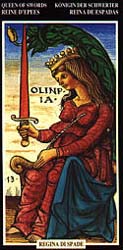
Due to the nature of the Trump card's imagery, the deck is often referred to as the "Warrior's Deck." I believe the "People's Deck" would be a far more accurate nickname, because the cards' imagery conveys the human condition and mindset of people from all stations of 16th Century Italian life. While the imagery is never offensive it can be blunt and does capture the concomitant joys, pains, passions, and struggles of life.
The deck serves as measure of social change over the past 500 years as well. A good example of this can be found by comparing the Rider-Waite Magician to its Sola Busca counterpart Panfilio. Panfilio lacks any overt tools of the Magician's or Alchemist's art. Nor do we get a very good look at his face. Of course the card does represent a character who by nature is secretive, but Panfilio may be depicted as he is because in the time the card was created The Church would have considered him a heretic and put him to death. Today most of us enjoy a religious freedom that was inconceivable in the 16th century. In our time the Rider - Waite Magician - robed and surrounded by tools and symbols that 500 years ago would have been interpreted as the devices of the Devil - stands openly before us practicing his craft free from concerns of persecution.
While comparing the Rider-Waite to the Sola Busca, it is also worth mentioning that it is commonly accepted that some of the symbolism in the Rider-Waite minors was influenced by the Sola Busca deck. When one compares the Three of Swords from the two decks it is apparent the Sola Busca did have some sway in the design of Modern Tarot's most influential deck.
Technically, the Lo Scarabeo edition is very well made. It is printed on sturdy card stock and the cards are vividly reproduced. The deck is easy to shuffle and work with. Each card is bordered in black and identified in English, French, Italian and Spanish. Although the cards are physically easy to work with, some might initially find the symbolism to be challenging. However, I feel anyone who gives the deck an opportunity to open up to them will be rewarded with a potent addition to their Tarot collection.
What does a typical Tarot deck consist of?
July 9, 2011 | Ginger Red Hawk
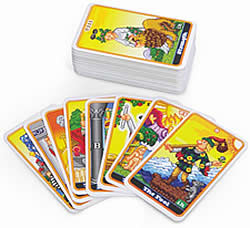
The Major Arcana:
The Major Arcana consists of 22 Trumps. These are the spiritual cards in the deck. They deal with the inner self. They represent the universal forces of nature and trace an individual's path as depicted in the Qabbalah i.e. the 22 steps that take you from the material world to the spiritual world of God. Spiritual readings are done only using the Major Arcana. They give insight into hidden talents as well as to an individual's karma.
The Trumps are:
The Fool
The Magician or Magus
High Priestess
Empress
Emperor
Hierophant
Lovers
Chariot
Strength
Hermit
Wheel
Justice
Hanged Man
Death
Temperance
Devil
Tower
Star
Moon
Sun
Judgement
World
The Minor Arcana
The Minor Arcana consists of 56 cards. They represent the physical or material aspect of life. The Minor is divided into 4 Suits (similar to the deck of playing cards) and the numbers in each Suit correspond with those of a playing deck. The 4 Suits are Wands, Cups, Swords and Pentacles. Each Suit also has 4 Court Cards - The Knight, Queen, Price and Princess.
Each suit represents one of the four elements (Wands-Fire, Cups-Water, Swords-Air, Pentacles-Earth), the three signs of the zodiac ruled by the element the suit represents and one of the four letters of the Tetragrammaton (Wands-Yod, Cups-Heh, Swords-Vau and Pentacles-Heh-Final).
Each of the Court Cards is also ruled by an element. Princesses are ruled by Earth, Princes by Fire, Queens by Water and Knights by Air.
Interpreting The Cards
Numerical Values
Each card in the deck is also assigned a numerical value. The numerical value is different from the numerological correspondent and the two must never be confused.
Numerical values are based on the face of the card. The Ace is an exception to this rule as it always takes the numerical value of 5. The Major Arcana cards are numbered 0-21 using Roman numerals. The Minor Arcana cards 2-10 take the face value of their card. Princesses always take the numerical value of 7. The remaining three Court Cards (Queens, Princes and Knights) take the numerical value 4.
Numerological Correspondents
The numerological correspondent helps to clarify the essence of the card. Since numerology deals mainly with the numbers 1-9, higher numbers are written in the unreduced/reduced format. Thus 10 is 10/1. While a knowledge of numerology makes the reading richer, it is not essential for a Tarot reading.
Astrological Correspondents
Each card is represented by an Astrological Correspondent. These include the signs of the Zodiac, the elements and the planets.
Dignified Vs III-Dignified
Some readers believe that each card has two meanings. If it shows in an upright position then the card is said to have a positive meaning. However, if the card is upside down or in a reverse position, it may indicate negative events. It may also indicate the unwillingness on the part of the querant to accept his or her hidden feelings and desires. Basically, it represent the subconscious of the querant.
So to brief it all up:
The Major Arcana has 22 cards, numbered 0-21 and they are spiritual in nature.
- The Minor Arcana has 56 cards divided into 4 suits. Each Suit has cards from 2-10 and 4 Court Cards. The Minor Arcana represents the material facets of life. Each Suit also has an elemental ruler.
- Each card is assigned a numerical value, a numerological and astrological correspondent and a Hebrew letter.
This explanation is a simple listing to get you started. To actually be able to make interpretations one would need to understand the nature of each of the Major Arcana cards in addition to the various combinations and implications of the Minor Arcana.
How To Do A Celtic Cross Tarot Reading
July 9, 2011 | Ginger Red Hawk
Interpretation:
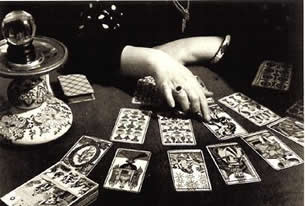
The Celtic Cross can thus be divided into two sections: The Circle or the Cross in the center (made up of 6 cards) and the Staff (made up of 4 cards) on the right. The Cross simulates the Celtic cross found throughout Ireland. The circle and cross represent the merger between spirit and matter and the unity of all events in time.
The Circle or the Cross is the feminine energy in this spread. It communicates with and complements the male energy represented by the Staff. This is the yin & yang, North & South, black & white, good & evil or the dual nature of all things manifested in human psyche.
The Circle or the Cross is also made up of two sections. The smaller Cross in the center, and the larger Cross or Circle surrounding the smaller one. The center cross represents the heart of the matter - what is central to you at the time of reading. The horizontal line in the larger cross shows time moving from your past (from the left) to your future (to the right). The vertical line is your consciousness moving from the unconscious at the bottom, to your conscious on the top. Together, these 6 cards give you an overview of your inner and outer environment at the time of reading.
The Staff represents your life and lies outside of the immediate situation. The Staff gives you guidance about yourself, your life and your future decisions.
Reading the Tarot Card Positions in the Celtic Cross Tarot Spread
Card 1: The Covering
This card represents the situation as it is now. It represents the general tone of reading and identifies the nature of the problem. It may also indicate the important events, issues, people, and influences around the question asked or the current situation.
Card 2: The Crossing
This card indicates the challenges or obstacles that stand in the way of the questioner. It can be good or bad. A positive card may suggest something that can help you. A negative card however, will block progress and will have to be removed to succeed.
Card 3: The Crown
This card is the basis of the matter. It is the true nature or the subconscious feelings of the individual about the matter being discussed. An extremely vital card, this is a foundation card. It indicates what it is that you already have that is supporting your current position. It might in fact indicate the very reason for the Tarot reading in the first place.
Card 4: The Root
This card indicates both present and passing influences about your query. It suggests recent events that may have influenced the matter at hand. It may also touch upon emotions that were stopping you from achieving your goal, but that you have resolved and are no longer such a strong influence.
Card 5: The Past
This card reflects the emotional state of the questioner. It is the conscious mind and the card needs to be read in conjunction with the questioner's known feelings. Some feel it represent the hopes and fears and it may indicate the best that you can wish for.
Card 6: The Future
This card indicates the path you are heading towards in the near future. It is what is evolving right now and will be shortly. It also hints towards elements that will influence the matter on hand in the near future.
Card 7: The Questioner
This card is about the questioner himself. His attitudes, the role he plays and how he deals with the situation and outside influences. It reflects the personality of the questioner.
Card 8: The House
This card is about external influences. The questioner's family, friends, colleagues and how they influence the situation. This is a good card if you want to know how other's feel about the situation or how they will respond to your future actions.
Card 9: The Inside
This card is about internal influences. It reflects the questioner's hopes and fears, and expectations of the future and how the situation will be resolved. It also indicates how the questioner might react to future events and to the possible outcome of the matter at hand.
Card 10: The Outcome
And finally, the one that everyone is waiting for. The outcome. This card reflects what will happen assuming you do exactly what you are already doing and don't change anything drastically. Tarots believe that the future is mutable. So if the outcome is not what you want, it is possible to change it by changing the course of your actions.
Integrating Other Symbolic Systems with Tarot
July 8, 2011 | Ginger Red Hawk
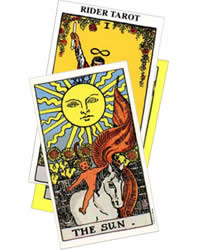
Numerology
Numerology assigns universal meanings to numbers. Briefly, they are:
1 Beginnings
2 Duality
3 Creativity
4 Foundation
5 Change
6 Balance
7 Awareness
8 Power
9 Humanitarianism
These numbers can be incorporated into a reading by adding the keyword for the number into the symbolic picture. For example, all of the fours represent some kind of foundation, whether it is emotional, spiritual, mental or worldly. Or, all of the five represent some kind of change.
James Wanless, PhD, creator of the Voyager Tarot, believes the Minor Arcana cards share the same energy of the Major Arcana cards of the same number. For example, he sees all sevens as bearing the same general energy as Major Arcana VII, the Chariot, with each Minor Arcana representing a facet of the Chariot. Do you see a correspondence?
As a brief exercise, line up your Minors by number to see if there's a connection between them for you.
Making Sense of Things
In some card decks, both specific tarot decks and other oracles, certain correspondences-astrology, numerology, kabbala, alchemy, and other-have been built into the symbolism of the cards. In such a case, learning the designer's system may seem to help with reading the cards, but if it doesn't resonate with our own perception of the symbolism, then it causes internal conflict and confusion. This, obviously, is not good.
The important thing is to discover what works best for you, what makes sense to you and, importantly, what makes sense to the person you are reading for, the querent. There is no use in tossing a lot of technical terms at a querent if it just confuses him. In the final analysis, we are looking for information and insight. Usually, the more clearly and directly we convey that information, the more useful it is. Whether we are doing divination or counseling, clear communication between reader and cards, reader and querent, and querent and cards is the essential need. Anything that gets in the way of that is not helpful. Remember the KISS principle: Keep it simple, sweetie!